
In modern logistics and warehousing operations, the efficient and safe transfer of goods from vehicles to loading docks is a crucial link. As a specialized piece of equipment designed specifically for building docks, the fixed loading dock leveler aims to seamlessly bridge the height difference between the two, enhancing operational smoothness. Unlike mobile or elevating platforms, fixed loading dock levelers play an irreplaceable role in various logistics environments thanks to their stable structure and reliable performance.
Core Value and Design Features
Reliability and Durability
Because the fixed loading dock leveler is installed in a fixed position, its structure is closely integrated with the building’s dock, giving it high load-bearing capacity and long-term stability. It is usually made of robust steel, capable of withstanding frequent operations by heavy equipment like forklifts and various harsh weather conditions. This design reduces moving parts, lowers the risk of failure, and concentrates maintenance on key moving components such as the hydraulic system and the lip plate, making daily inspection and maintenance more straightforward and convenient.
Constituent Elements
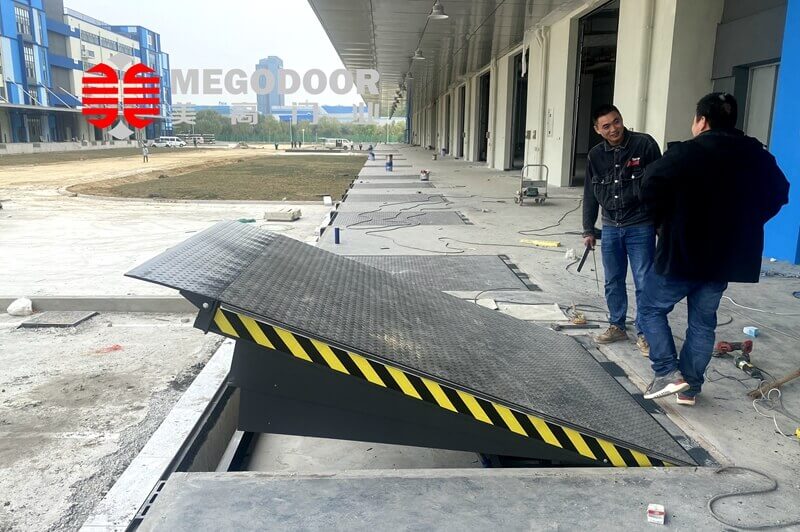
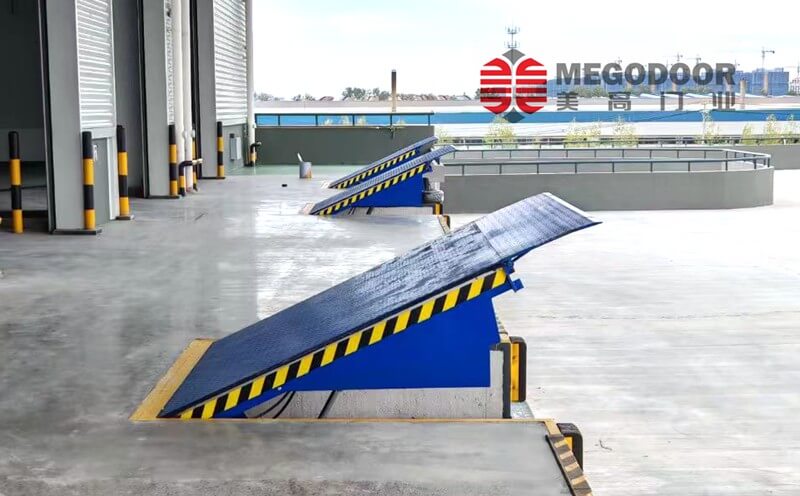
A complete fixed loading dock leveler mainly includes the following parts:
- Platform Base: Firmly cast or welded to the edge of the dock, forming the foundation of the entire device.
- Adjustable Lip Plate: As the core moving component, it connects tightly to the floor of the vehicle’s cargo box by flipping up, extending down, or sliding sideways, effectively filling the gap between the dock and the vehicle. Driven by a hydraulic system or mechanical spring system, it ensures smooth and powerful movement.
- Safety Devices: Includes safety locks to prevent forklifts from falling accidentally, safety railings or sensors to protect personnel when the vehicle is not in place, and control switches to ensure operational safety.
Application Scenarios and Advantages
Widespread Application
Fixed loading dock levelers are widely used in places that require high-frequency, large-batch loading and unloading operations, such as large distribution centers, manufacturing raw material and finished product warehouses, cold chain logistics centers, and large retail warehousing hubs. These places may handle loading and unloading tasks for dozens or even hundreds of trucks every day. The fixed platform provides continuous and efficient docking capabilities, significantly reducing preparation time for each vehicle, accelerating vehicle turnover, and improving overall logistics efficiency.
Selection and Installation Considerations
Selecting and installing a fixed loading dock leveler requires consideration of multiple factors, including dock height, the range of common vehicle cargo box heights, and special requirements of the operating environment (such as low-temperature operation, sealing, dustproofing, and anti-corrosion treatment). A professional team is responsible for the installation, ensuring the platform is safely and firmly integrated with the dock’s building structure, with all electrical and hydraulic lines up to code, and conducting thorough debugging and safety testing.
Usage and Maintenance
Operation Training and Maintenance Points
Operators need to receive training to master the correct operating procedures, especially regarding vehicle docking, lip plate extension and retraction, and safety device reset. Daily maintenance includes regularly cleaning debris, checking the lip plate seals, lubricating moving hinges, and checking the hydraulic oil level and for leaks. Regular professional inspections focus on structural integrity, hydraulic system pressure, safety device effectiveness, and electrical system insulation performance, preventing potential failures.
Long-term Benefit Analysis
Compared to temporary loading and unloading methods, fixed loading dock levelers have a higher initial investment, but they have significant advantages in improving operational efficiency, reducing labor intensity, reducing cargo loss, and the risk of workplace injuries, making them a standard configuration for modern logistics facilities.
The fixed loading dock leveler may seem simple but is vitally important. Through the perfect combination of mechanical and electronic control technology, it solves the last-meter connection problem in the loading and unloading process. Its design emphasizes durability and operational safety, serving as an important tool for improving the standardization and modernization of warehousing logistics operations. For enterprises pursuing efficient and safe logistics, investing in fixed loading dock levelers is undoubtedly a wise choice.
- A fixed loading dock leveler is a specialized piece of equipment designed for building docks, aiming to achieve efficient and safe transfer of goods between the dock and transport vehicles. With its reliability and durability, it has become an indispensable key facility for high-frequency loading and unloading locations.
- The platform is mainly composed of a fixed base, an adjustable lip plate, a drive system, and multiple safety devices. When selecting and installing, factors such as dock height, vehicle specifications, and operating environment requirements must be comprehensively considered. Its application not only improves loading and unloading efficiency but also enhances operational safety.
- Correct operating methods and regular maintenance are the foundation for ensuring the long-term stable operation of fixed loading dock levelers. Although the initial cost is high, its value in improving overall logistics operational efficiency in the long run cannot be ignored.